

Introduction: The Reformed Tradition of Open Theological Combat
The Reformed world is no stranger to controversy and debate. In fact, one could argue that controversy is not merely incidental to Protestantism but essential to it. The Reformation itself did not begin with a revival meeting, a worship band, or a vision statement. It began as an academic disputation. An obscure Augustinian monk affixed ninety-five theses to a church door in Wittenberg, inviting public debate over indulgences. That monk, Martin Luther, would go on to engage in some of the most consequential theological controversies in Western history, including a sustained written exchange with the Dutch humanist Desiderius Erasmus over the bondage of the will.
This pattern was not unique to Luther. Ulrich Zwingli, John Calvin, Heinrich Bullinger, and later Reformed scholastics all assumed that theological truth was refined through rigorous public argument. Confessional documents themselves are artifacts of debate. The Marburg Colloquy, often cited as a tragic failure of unity, nevertheless demonstrates that the early Reformers believed doctrinal disagreement deserved face-to-face, intellectually serious engagement. Likewise, the continental and English confessions and canons stand as monuments to disciplined theological labor conducted in the open, not behind closed doors or administrative smoke screens.
Against this backdrop, it is striking how allergic the modern Reformed world has become to sustained academic dispute. Rather than clarifying disagreements through careful argument, institutions increasingly manage controversy through committees, procedural maneuvers, and carefully curated public statements. This shift away from debate and toward bureaucratic containment is one of the central indictments Gary North levels in Westminster’s Confession: The Abandonment of Van Til’s Legacy.
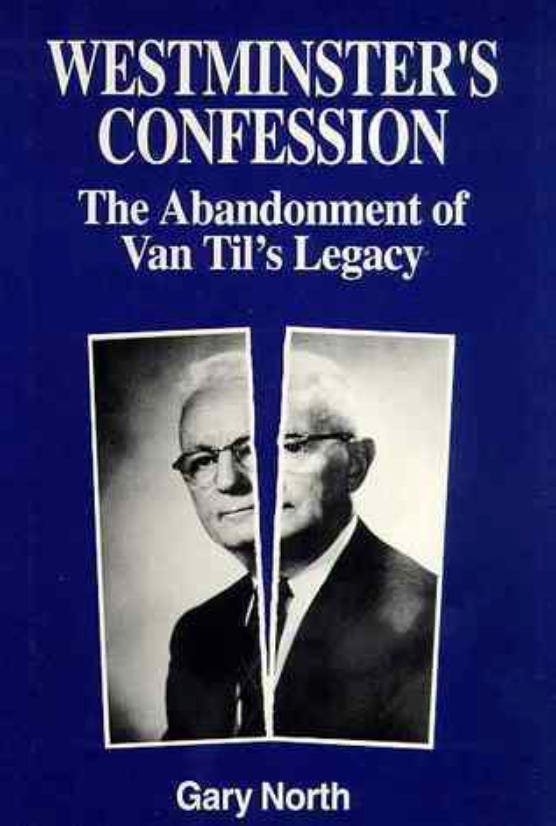
North’s book is not a gentle lament. It is an autopsy.
Gary North, now deceased, was never a figure who inspired consensus. He was deeply involved in the Reconstructionist movement and its many internal conflicts, and his prose often reflects a polemical temperament sharpened by decades of institutional battles. This review should not be mistaken for a blanket endorsement of North’s broader corpus. It is not. Rather, it is an engagement with one particular book addressing one particular period in the history of American Reformed theology. By North’s own estimation, and by the documentation he provides, it was not a flattering period.
To understand the force of North’s argument, one must first understand the legacy he claims was abandoned.
Van Til’s Legacy and the Reconstructionist Inheritance
Cornelius Van Til stands as one of the most influential figures in twentieth-century Christian apologetics. Building on the biblical-theological work of Geerhardus Vos and the dogmatic depth of Herman Bavinck, Van Til challenged the dominant apologetic models of his day. He argued that traditional evidentialist and Thomistic approaches failed to reckon adequately with the noetic effects of sin. Human reason, Van Til insisted, is not religiously neutral. It is covenantally situated, either in submission to God’s revelation or in rebellion against it.
Van Til’s transcendental method began not with autonomous reason but with the self-attesting authority of Scripture. Christianity is not merely true because it fits the facts. It is true because without it, no facts are intelligible at all. Logic, morality, science, and meaning collapse into absurdity apart from the triune God revealed in Scripture. This was not an anti-intellectual move. It was an attempt to be ruthlessly consistent with the biblical doctrine of sin and revelation.
Importantly, Van Til deliberately avoided constructing a full political theology. He confined himself to epistemological and apologetic questions, leaving others to explore the implications of his method in ethics, law, and civil order. A group of thinkers took up that task. They came to be known collectively as the Reconstructionists.
Reconstructionism sought to apply the lordship of Christ to every sphere of life, including politics and law. Its most substantial expression was R. J. Rushdoony’s massive Institutes of Biblical Law, a three-volume attempt to articulate the continuing relevance of God’s law for society. Rushdoony was not operating in isolation. Van Til himself publicly acknowledged Rushdoony’s assistance in proofreading The Defense of the Faith, a fact North repeatedly highlights to undermine later attempts to distance Van Til from Reconstructionist concerns.
Among the most formidable figures in this movement was Greg Bahnsen. Bahnsen was not a fringe agitator or an intellectual lightweight. He was Van Til’s chosen successor to teach apologetics at Westminster Theological Seminary. He earned his PhD in philosophy from the University of Southern California and produced what remains one of the clearest expositions of presuppositional apologetics in Presuppositional Apologetics: Stated and Defended.
Bahnsen’s association with Reconstructionism and his defense of theonomy, however, proved decisive. He was never hired by Westminster Seminary. North treats this decision not as an isolated personnel choice but as a symbolic rupture.
Westminster’s Political Turn: Theonomy, Power, and Procedural Control
Theonomy, broadly defined, is the view that God’s law, as revealed in the Mosaic code, retains abiding moral authority. Theonomy does not require wooden literalism or simplistic application. Debates over general equity, civil penalties, and redemptive-historical fulfillment are acknowledged within the movement itself. What unites theonomists is the conviction that God’s revealed law cannot be dismissed as irrelevant without implicitly denying Christ’s lordship over the nations.
North argues that Westminster Seminary did not defeat theonomy through careful theological argument. Instead, it neutralized it through institutional politics.
The immediate catalyst for North’s book is Theonomy: A Reformed Critique, a multi-author volume produced largely by current or former Westminster faculty. North’s first line of attack is devastating in its simplicity. The contributors, he demonstrates at length, do not agree with one another. They offer mutually incompatible accounts of the law, redemptive history, and the relationship between church and state. Their only point of consensus is their shared rejection of theonomy.
Chapter by chapter, North catalogs these contradictions. Some authors affirm ongoing moral continuity while denying civil application. Others appeal to redemptive-historical shifts without explaining how moral norms survive those shifts. Still others critique caricatures of theonomy that few theonomists actually hold. North’s tone here is merciless. He does not merely assert incoherence. He quotes, compares, and cross-examines.
Yet the book is not only about ideas. It is about power.
North situates the entire controversy within the earlier Norman Shepherd affair. Shepherd, a Westminster faculty member, was accused of promoting a doctrine of justification that blurred the distinction between faith and works. After years of internal conflict, he was removed. North argues that this episode taught the seminary faculty a crucial lesson: theological outcomes could be achieved through procedural control rather than open debate.
According to North, this marked a turning point. In the years following Van Til’s retirement, Westminster Seminary increasingly distanced itself from Van Til’s method, even while continuing to invoke his name. Apologetics courses were taught by individuals who later departed from historic Reformed positions. Faculty members promoted views on church office, abortion, and ethics that sat uneasily with confessional commitments. The sufficiency of Scripture, North argues, became a slogan rather than a controlling principle.
What replaced it was a desire for academic respectability.
The Abandonment in Practice: Incoherence, Respectability, and Frame’s Synthesis
North reserves particular attention for John Frame, whose irenic style and perspectivalism he treats as emblematic of Westminster’s transformation. Frame’s ability to synthesize opposing positions without decisively ruling in or out controversial implications strikes North as evasive rather than charitable. The reader is often left unsure what, if anything, is actually being rejected beyond the excesses of others.
By the end of the book, North’s thesis is unmistakable. Westminster Seminary did not merely disagree with theonomy. It abandoned the epistemological rigor of Van Til in favor of institutional stability and academic acceptance. The irony, North insists, is profound. An institution founded to defend presuppositional theology ultimately rejected its implications when they became inconvenient.
Whether one agrees with North’s conclusions or not, Westminster’s Confession forces the reader to reckon with uncomfortable questions. Can a theological institution claim fidelity to a method while refusing its logical outworking? Can confessional integrity survive when controversy is managed rather than argued? And is the modern Reformed fear of political theology a mark of wisdom or of retreat?
North does not pretend to be neutral. He does not ask permission. He indicts.
And that, perhaps more than anything else, is why this book remains worth reading.